Gather the latest news about Groover Labs, Wichita Coworking, Startups, and Founders on our blog.

Member News: QuickHire
Wichita sisters Deborah Gladney, and Angela Muhwezi-Hall, co-created the app QuickHire, a job search platform for people in manufacturing, service, retail or other similar fields outside of white-collar employment. The coronavirus pandemic pushed them to launch the app in early September.
This post contains both copy and links to three articles featuring QuickHire co-founders Deborah Gladney and Angela Muhwezi-Hall. They appear in the order they were published.
September 28, Wichita Eagle: Need a job in service or manufacturing? Wichita sisters made an app for that
September 28, Wichita Business Journal: Wichita sisters launch app for skilled labor hiring
October 16, Wichita Business Journal: QuickHire founders stress need for representation in venture capital
Wichita Eagle: Need a job in service or manufacturing? Wichita sisters made an app for that
By Megan Stringer
When the coronavirus pandemic began to spur massive layoffs in March, two sisters from Wichita had an idea to help: an app, set up like a dating app, that can connect job seekers with open positions to be drivers, grocers, packers or manufacturers.
Just about six months later, Deborah Gladney, 33, and Angela Muhwezi-Hall, 30, launched the QuickHire app. While the idea was born years ago, they knew when the coronavirus pandemic hit the U.S. and Wichita that it was the right time to introduce their business. They hope it will help people impacted by severe layoffs in industries like service, retail and hospitality. Almost 1,000 people have downloaded the app so far.
QuickHire’s design might look familiar to some. After job-seekers create their profile, they can swipe left or right on job postings in their area, similar to a dating app. QuickHire will ask candidates various onboarding questions to pair them with a job that could be a good match.
In recognition that some workers might not have a resume, they can also record a 30-second introductory video for the profile.
“Millennial workers need technology they’re used to,” said Gladney.
Job offerings and the app itself are still evolving, after the official launch earlier this month. But you won’t see white-collar office jobs that are otherwise found on common employment websites. The sisters chose to focus on jobs that might not require a college degree, such as those in manufacturing, service or retail.
The job search process in those fields isn’t always as uniform like it is in more traditional employment settings, Muhwezi-Hall said. Sometimes workers have to go in-person to ask if a company is even hiring. They aren’t as likely to see a posting for a server at a restaurant on LinkedIn as they are to hear about it by word of mouth. The app aims to change that and build more respect for service-sector jobs along the way.
Gladney and Muhwezi-Hall both grew up in Wichita. The app has grown so much since March that QuickHire is now Muhwezi-Hall’s full-time job. She currently lives in Los Angeles, but is preparing to move back to Wichita soon to work on QuickHire with her sister and devote more attention to its growth.
You don’t have to live in Wichita to use QuickHire in your job search, since you can enter your zip code to find openings in your area. But the sisters are looking to partner with local educational institutions and some larger Wichita companies. Those conversations are ongoing.
While the app’s services might be needed during the ongoing recession, it’s not easy to start a new business because of the economic climate. Gladney and Muhwezi-Hall said they’ve had to jump through some extra hurdles to find investment capital and have ended up largely self-funding their project so far. It’s pushed them to get creative about marketing and growing.
“There were certainly concerns launching during a pandemic, but there was an opportunity, too,” Gladney said. “Companies had to pivot, and so did people.”
For now, the app is just in its initial phase. When the team rolls out updates, they plan to add a 48-hour turnaround time for job seekers to hear back from employers, even if the message is that they’re still under consideration. Muhwezi-Hall hopes this will encourage candidates who otherwise might not hear back after applying for a position.
For the sisters, QuickHire is about more than just connecting people with work. Their parents immigrated to the U.S. from Uganda and supported their family of seven with these types of jobs, Gladney said. It’s about bringing dignity and respect back to the jobs that help keep the economy running, but aren’t always in the spotlight.
“We wanted to build a community for these workers,” Muhwezi-Hall said. “Because COVID-19 has shown us how essential they really are.”
Workers and employers can download the QuickHire app in either the Apple or Google Play store on their smart phones.
Wichita Business Journal: Wichita sisters launch app for skilled labor hiring
by Daniel McCoy
Seeing a need to help technology connect employers and job seekers in the trades and other traditional blue-collar industries, two Wichita sisters have launched an app called QuickHire.
Deborah Gladney and Angela Muhwezi-Hall say they had had the idea for the app for some time, but the onset of job losses earlier this year due to Covid-19 accelerated their efforts to bring the platform to the market.
That spurred a 4 a.m. phone call between the two in March, when it was decided, Muhwezi-Hall says: “Now is the time.”
QuickHire is essentially targeting jobs that do not require college degrees — including an emphasis on manufacturing and logistics — an employment sector the sisters say has lagged when it comes to technology-aided hiring.
Using a swiping interface familiar to the online dating world, QuickHire helps employers and potential employees learn about each other and quickly connect when there is mutual interest.
“This is technology they are used to,” Gladney says.
After beta testing in August, QuickHire officially launched earlier this month and is available for download in the Google’s Play Store or the App Store for Apple.
“The response has definitely been great,” Muhwezi-Hall says, noting the platform already has nearly 1,000 users. “Now we really want to implement those features that are critical to the success of QuickHire.”
That includes notification within 48 hours of an employment offer — or if one will not be made or accepted — and others like video introductions, all while building out users on both the applicant and employer side of the platform.
And still to come, they say, will be more additions that make the platform a pipeline to connect people to training and other resources to help them navigate an entire career — not just initially landing a job.
“The jobs portion is just one part of our vision,” Gladney says.
Wichita Business Journal: A Need For Representation
QuickHire founders stress need for representation in venture capital
By Daniel McCoy
Most tech founders don’t look like the founders of QuickHire.
Wichita sisters Deborah Gladney and Angela Muhwezi-Hall, the daughters of Ugandan immigrants, founded QuickHire earlier this year.
The hiring app leverages swipe-left-or-right technology familiar to the online dating world to match employers and job seekers in sectors like manufacturing — where that type of technology has lagged behind.
But getting to this point — the app launched in September and now has more than 1,000 users — the sisters say, has been a lesson in the unfortunate power of implicit bias.
“Growing up as Black women … this is something we have faced all our lives,” Gladney says. “But I think being the children of immigrants, we never used it as an excuse. I work hard and I let my work speak for itself. But I feel like this is the first time no matter how hard I work, I can’t get something.”
Where that’s come through the clearest, they say, has been in their pursuit of venture capital.
“There have been so many times Deborah and I have done presentations with major VC firms and they want an extra set of proofs, extra validation,” Muhwezi-Hall says.
As an example, QuickHire was up for a national accelerator program and the sisters were told for several rounds they would be a perfect fit.
Then, they were eliminated because they were told QuickHire was in too competitive a space — something they feel would've been apparent from the start.
“They say these are the requirements to get certain access to capital and if you’re checking all these boxes, you can’t help but wonder if some of these underlying biases come into play,” Gladney says.
The sisters know they’re trying to disrupt the market with their product — which has a growing number of real-world users as the truest form of validation.
But they are disrupting it as well.
“They’re not used to seeing two Black women build a labor marketplace,” Muhwezi-Hall says.
When someone on a panel tells first-generation Americans who, like many of their peers are also the first in their family to go to college, that they should go to friends and family for the $200,000 they need, the sisters say the disconnect is obvious.
It wasn’t lost on them that no one on that panel looked like them.
And that, they say, underscores the importance of representation.
“If there were more of us in those spaces, they would know and would be able to give us more useful advice,” Muhwezi-Hall says.
QuickHire
Founders: Angela Muhwezi-Hall and Deborah Gladney
Year founded: 2020
Platform users: More than 1,000
Members in the News: KingFit
Read about the latest partnership between Groover Labs member Miguel Johns and his startup KingFit with BioTel care. Very exciting! Congrats, Miguel.
Read about the latest partnership between Groover Labs member Miguel Johns and his startup KingFit with BioTel care. Very exciting! Congrats, Miguel. Read the article on Startland News here.
Startland News: KingFit prescription for growth: DiabetesCare startup becomes a pandemic must-have
By Austin Barnes
WICHITA — A new partnership with a medical giant is adding even more fuel to a momentous 2020 for Kansas-grown KingFit, said Miguel Johns.
Miguel Johns, KingFit
The startup has entered an agreement with BioTel Care, the diabetes division of BioTelemetry — a $2 billion publicly-traded company, that aims to improve health outcomes through innovation.
“This partnership opens doors to new employer and health plan customers with immeasurable, increased credibility,” Johns, KingFit founder, told Startland News.
“Healthcare is a risk-averse industry, so having a partner like BioTel Care puts our startup on a new level in the eyes of the market.”
The partnership follows the acquisition of another KingFit product by one of its customers earlier this year and specifically elevates its DiabetesCare platform — a tracking application that allows diabetes patients to track their glucose levels, caloites, exercise, and mental health status.
Click here to read more about the company, a graduate of the Enterprise Center in Johnson County’s Pitch Perfect program.
“The biggest benefit is our opportunities for revenue. We have multiple offers coming to market with BioTel Care including both direct to consumer and employer-based offerings,” Johns explained.
“We’ve been learning over the years what it means to do business to business deals in healthcare. It takes relationships, time, patience, and collaboration. We’ve been able to use our previous experiences to handle the BioTel relationship correctly,” he said, noting the deal has already seen the companies participate in a pilot project that paired the DiabetesCare platform with BioTel Care’s cellular glucose monitoring device.
“Their team is amazing and our skills complement each other very well. I think that is key. We are very good at what they lack, they provide what we do not. Together we have a unique offering both for direct to consumer and for employer groups.”
Johns said the deal was in the works prior to the COVID-19 pandemic — a global ordeal that’s accelerated the need for healthtech products, he added.
“We were able to continue moving forward and launch our pilot as businesses began to reopen. COVID has accelerated the adoption of products like ours as they have gone from nice-to-have to must-have.”
Welcome New Members: Kansas Global Trade Services
Kansas Global Trade Services joined Wichita coworking space Groover Labs in September. Rethinking their traditional office environment gave them increased flexibility, and moving to Groover Labs was a natural fit.
The below release was issued by Kansas Global Trade Services on 10/14. We are pleased to have them as new members at Groover Labs!
Kansas Global Trade Services Shifts Operations to Digital Workforce
By David Thacker
Kansas Global Trade Services, an international trade consulting firm, announced its shift to a new, more agile workplace model that matches the firm’s digital and physical resources to client’s individual requirements—regardless of the customer’s geographic location.
Kansas Global transitioned to the new approach to serve the needs of its clients, eliminate geographic limitations, and open the doors to bridge departments and offices across disparate locations and continue the growth trajectory of the firm. The emergence of COVID-19 during the design process introduced a new set of real-world challenges that helped to inform the firm’s transition to the new business model—and speed up the firm’s efforts to position itself at the digital vanguard of trade consulting.
“Kansas Global is shifting day-to-day operations away from what has been primarily an office-based workplace—and into a virtual environment,” said Kansas Global Trade Services President & CEO Karyn Page. “Our business model also includes scalable access to co-working facilities on an as-needed basis. The implementation of this new operating paradigm—which was already underway, better accommodates the needs and preferences of our clients—in Kansas, across the United States and globally.”
By leveraging technology to move the firm away from a rigid, traditional workplace model and toward a more digitally defined enterprise, the firm is gaining the ability to enhance the quality of its client engagements though faster communications, enhanced information-sharing, better collaboration, and more effective decision-making.
“Kansas Global’s new business model allows it to provide its customers with a complete range of both remote and in-person services by combining the flexibility of digital technology with access to boots on the ground—whenever and wherever they are needed,” said Maxi Volt Corp. President Mark Wingate, a member of the Kansas Global Board of Directors. “This integrated strategy allows Kansas Global to provide its customers with highly customized service at all times, and when required, to engage with them personally at whatever time and place they require.”
Page noted that the firm will continue to adjust its model to address the quickly evolving complications to trade presented by the COVID pandemic.
“Providing sound, timely and smart trade consulting is a complicated undertaking even in the most prosperous economic times,” Page said. “We at are confident that—even amid today’s challenges—our redesigned, approach to this task will set a new standard in customer-centric trade consulting.
Kansas Global will continue to have a presence in Wichita, Kan., at Groover Labs.
###
Kansas Global Trade Services is an international trade consulting firm that provides customized consulting and export services to help businesses, governments and other organizations establish, expand and strengthen their presence and participation in international markets. Since 1987, our experienced export assistance professionals have helped our clients design market-entry strategies that cut through red tape, identify, and leverage partnership opportunities, overcome documentation challenges, and fast-track sales and relationships abroad. For more information visit, www.kansasglobal.org
Welcome New Members: Kansas Creative Arts and IdeaTek
Over the past month our we’ve had an uptick in membership, an encouraging sign for what we’re trying to accomplish here at Groover Labs. Read about our new members below. We are delighted to have them join our community!
Welcome to IdeaTek and Kate Van Steenhuyse!
Over the past month our we’ve had an uptick in membership, an encouraging sign for what we’re trying to accomplish here at Groover Labs. Read about our new members below. We are delighted to have them join our community!
Kansas Creative Arts Industries Commission’s Kate Van Steenhuyse
Kate is the point of contact for South Central and Southwestern Kansas for the Kansas Creative Arts Industries Commission, a group focused on the creative industries sector of the Kansas economy. Van Steenhuyse helps arts and cultural institutions with grants, funding opportunities, program development, and new initiatives to integrate arts and culture into all aspects of community and economic growth and development. Kate is also the founder and executive director of Harvester Arts, a venue that provides a thoughtful platform for visual arts experimentation that engages the community through both critical dialogue and the creation of new work. Welcome, Kate!
IdeaTek’s Ben Wolff
Ben is a business development and marketing manager at IdeaTek. He has multiple degrees in business and finance, and he has worked for and with some of the largest businesses in the country. Ben’s background includes strategy development, complex negotiations, developing new business lines, and constructing go-to-market strategies. IdeaTek, a broadband service provider headquartered in Buhler, Kansas, provides Groover Labs with its ultra-fast gigabit fiber internet access, a material benefit to all our members. Welcome, Ben!
Member News: IdeaTek Awarded $13.1 Million Grant
Buhler-based IdeaTek will receive $13.71 million from four Connectivity Emergency Response Grants (CERG) awarded by the state in response to the novel coronavirus to extend its fiber-optic network to unserved and underserved areas in parts of more than a dozen area counties.
Great news for Groover Labs member (and internet service provider) IdeaTek, who has been awarded $13.1 million from the Connectivity Emergency Response Grant to extend its fiber network to unserved and underserved areas in parts of more than a dozen Kansas counties. Congrats, IdeaTek! Read the article on HutchNews here.
HutchNews.com: IdeaTek awarded $13.7 million to extend internet access
By John Green
A grant announcement made Thursday afternoon brings new meaning to the phrase “high-speed internet.”
Buhler-based IdeaTek will receive $13.71 million from four Connectivity Emergency Response Grants (CERG) awarded by the state in response to the novel coronavirus to extend its fiber-optic network to unserved and underserved areas in parts of more than a dozen area counties .
The company is teaming up with several local and state nonprofit agencies in new ways to leverage the state funding and qualify for the grant.
The challenge, however, is that the company must spend the millions going toward installing some 300 miles of new line and related wireless equipment within the next 80-some days.
That’s because of a federal government requirement attached to money, which flowed from the federal CARES Act, that it be spent before the end of the year or it will have to be repaid.
To put the challenge in perspective, when the Federal Communication Commission awarded the company $6.2 million through its Connect America Fund (CAF II) “reverse auction” in 2018, IdeaTek was given five years to spend the dollars.
Who will be served
The plan is to provide gigabit fiber to more than 4,200 properties, plus high-speed wireless to another 3,352 homes that now have less than 25/3 Mbps service, according to IdeaTek spokesperson Abby Stockebrand.
The projects are centered on several areas, primarily in Meade, Chase, Reno and Edwards counties, but also extending into parts of several counties that neighbor them.
Towns scheduled to receive gigabit fiber internet include: Langdon, Arlington, Abbyville, Willowbrook, Pretty Prairie, Kismet, Plains, Meade, Fowler, Minneola, Bloom, Kingsdown, Ford, Cedar Point, Elmdale, Strong City, Cottonwood Falls and Cullison, she said.
“Our coverage area is increasing exponentially, given the exponential need for high-speed internet,” Stockebrand said. “We have been testing our new age wireless technology in Meade County and the success of this gives us the confidence to expand widely throughout Kansas and provide people a service they need immediately.”
IdeaTek’s employment numbers have already jumped from 40 to 60 employees, and Stockebrand said there’s a possibility it will add up to 60 more jobs over the next three years. The growth, she said, is not all due to the new grant, but includes organic expansion of its network thanks to the new lines, in addition to the past CAF II award.
Partners
As part of the grant application, the Hutchinson Community Foundation agreed to provide a $215,000 loan to help cover the required private match, which attracted an additional $225,000 loan and $25,000 grant from the Kansas Community Investment Fund, a fund created through a partnership between the Kansas Health Foundation and NetWork Kansas.
Greater Hutch, the economic development partnership for Reno County, committed to a $30,000 workforce grant, and will work with the United Way of Reno County to connect with low-income residents to help pay for the high-speed internet service.
IdeaTek must provide the remainder of the $3.5 million private investment.
The need, noted several people working to secure the award, has been made both more obvious and ever greater by the global virus pandemic, which has forced more students to learn and many employees to work from home.
“COVID has really provided a focus on the need for broadband expansion,” said Sen. Ed Berger, R-Hutchinson. “It has absolutely magnified the importance of having broadband access across the state.”
“I had a mom friend talking about having to leave the house at 6:30 at night to drive around town to find a Wi-Fi hotspot,” said Aubrey Abbott Patterson, director of the Hutchinson Community Foundation. “So many kids don’t have access to the internet. Whether it’s spotty or unavailable, as a parent, that’s pretty stressful.”
IdeaTek came to them early on to begin discussions about what could be done, Patterson said.
“I applaud IdeaTek for initiating conversations with superintendents and teachers and counselors to say ‘what is the scope of the issue in schools and how can we help kids who are now at home and trying to study,” Patterson said. “Daniel (Friesen, company co-founder and Chief Innovation Officer) then said to us ‘we need help to fix it.’ That’s where we started. We wanted to have a conversation and be a part of it, to figure out how to invest and to change lives.”
New Foundation program
The five-year loan from the foundation – only the second of its kind by the agency – is providing part of a 20% match IdeaTek had to pledge to secure the grant. The company will pay it back as it builds out its fiber-optic system and new broadband clients come online, Patterson said.
“We don’t have enough money to fix the infrastructure and provide rural broadband, but we can make an investment in a locally owned internet provider to get that infrastructure built quickly,” Patterson said. “Our investment is a small bit to make that happen.”
“We expect to do more of these,” Patterson said of her agency’s loan. “We were looking for opportunities to invest locally. Why just put our money in the stock market when we can invest it here and grow jobs?”
Their goal ultimately, she said, is to have 5% of their total assets, which are currently $80 million, invested in Hutchinson.
Affordable access
They became aware of the need early in the pandemic of people who couldn’t afford internet access, said Lisa Gleason, executive director of the United Way of Reno County.
“And we knew of other partners who were also willing to step up and make an impact on this daunting issue,” she said.
“That’s really what it’s about, identifying issues in our community and coming together as a collective to say ‘we can make a deeper impact if we work together to solve it,’” she said. “We’re helping to provide a portion of the funds that will go directly to those who are lower income.”
They haven’t established exactly how the program will work, Gleason said, “but if they can show us they have a need and can’t afford it, we’ll figure out how to get dollars to them to get set up.”
What sets Reno County apart, said Rep. Jason Probst, D-Hutchinson – who has a daughter and grandchildren living in rural Reno County with no access to the internet – is “that we don’t throw up our hands and say ‘it can’t be done.’ ”
“Under this idea of a public-private partnership, one of the best components is where you deliver public and private resources to create the most public good,” he said.
“I would say the next step is to make sure we don’t continue to push out just into unserved areas, but the underserved,” he said, noting current broadband service maps are inaccurate. “We have to keep in mind going forward what the demand is not just today, but the needs in 20, 30 or 50 years.”
How Do We Produce Our Monthly Tech Talks?
Our tech talk on 9/22 presented a new series of logistical AV challenge. Switching to a digital encoder and YouTube Live created a richer and more diverse show.
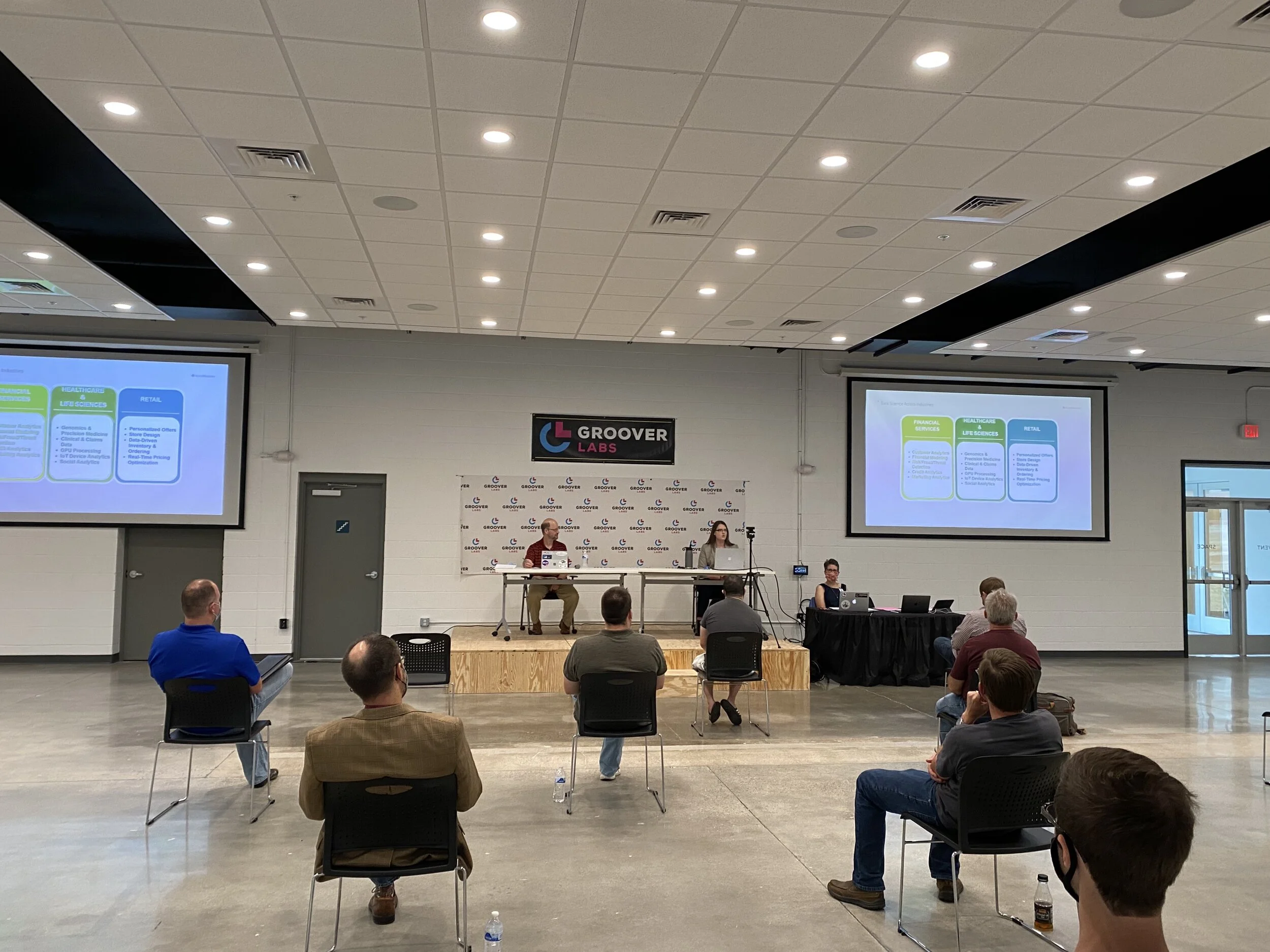
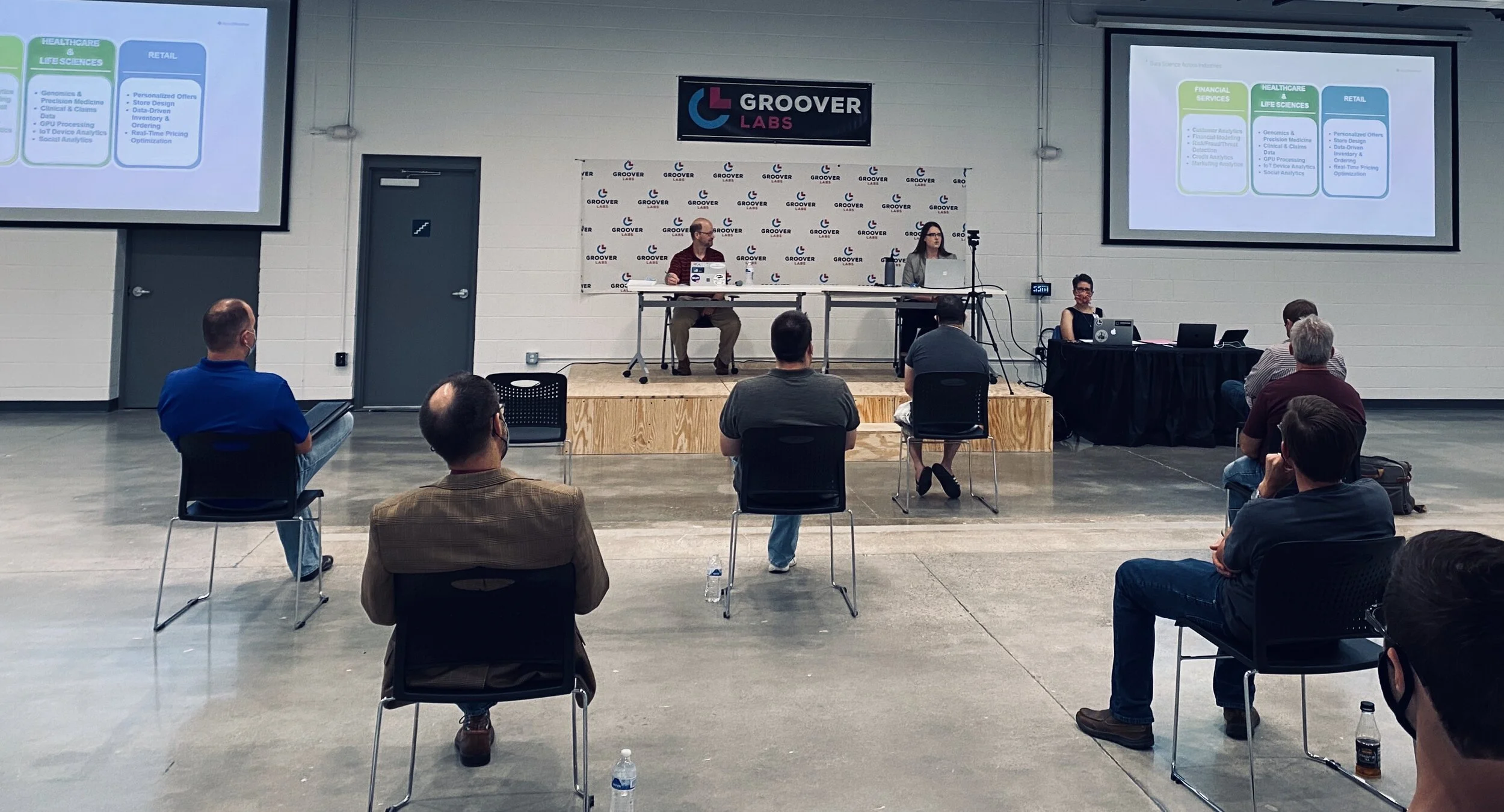
Earlier this month we hosted the second in our speaker series with data scientist Jennifer Akers. She discussed the emerging field of data science and how data analyses impact business strategy. In addition, Akers provided information about how to prepare for a career in data science or how to pivot a current career into the field. Rounding out the presentation was a conversation about a lack of diversity in the field and how we can do better.
We host these events because we hope to keep our community connected during Covid-19. We understand, however, that some people are eager to attend events in person while others would rather watch from home, either because of Covid-19 or for convenience. To reach both audiences, we developed a hybrid in-person and online format, which requires, essentially, the creation of two separate shows we then mold into one—a final product suitable for both our event space and in your home.
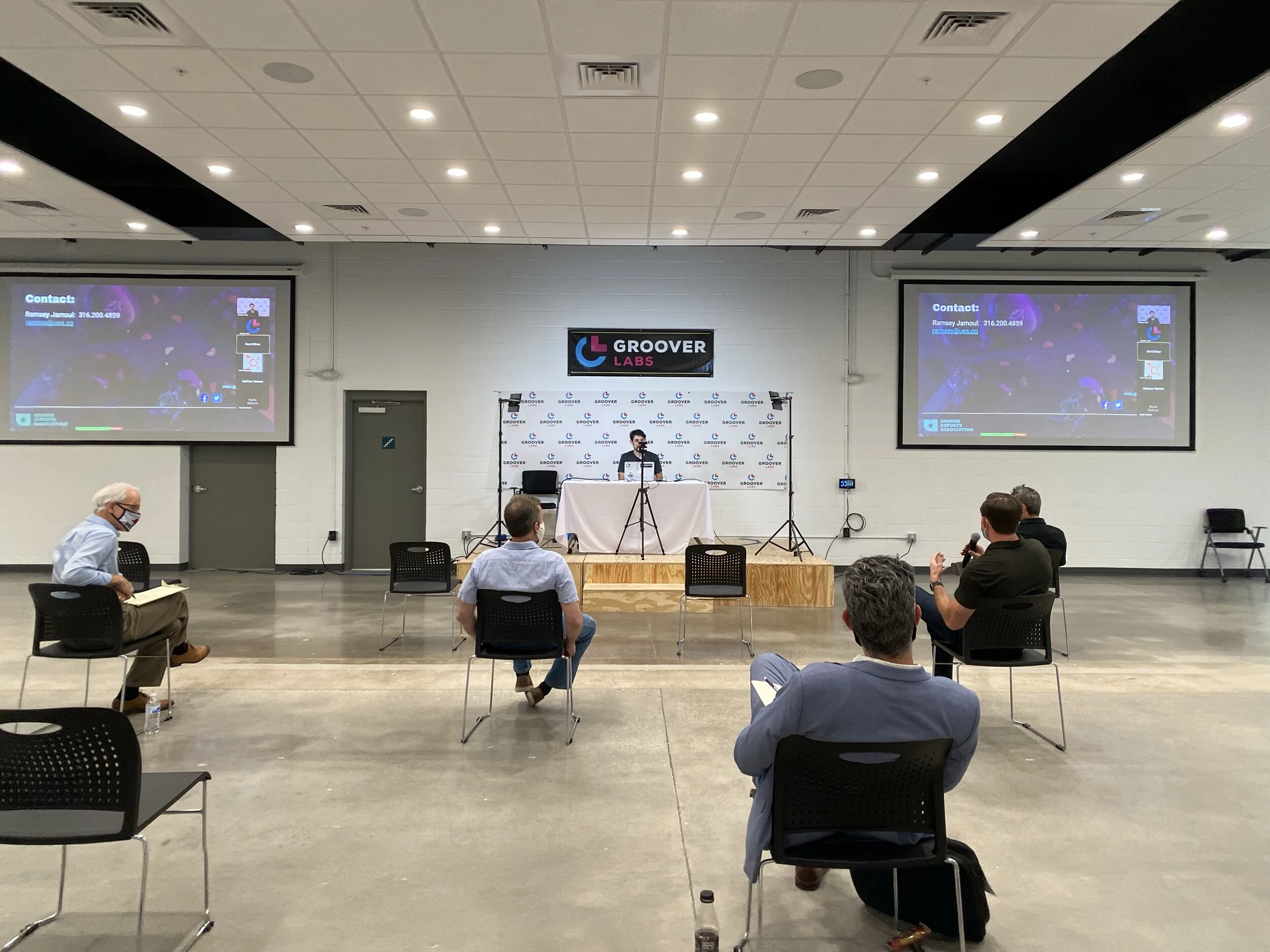
If you attended our September event online, you may have noticed a new format. We changed video platforms from Zoom to YouTube Live. For the first event with Unified eSports Association CEO Ramsey Jamoul, we used the online video meeting and webinar platform Zoom. You’ve certainly heard of Zoom by now, as its ease-of-use and high-quality video delivery has become the de facto platform of choice in 2020. We really liked Zoom, but we learned from this first event that we had needs beyond a standard meeting or webinar.
YouTube Live
We debated and settled on YouTube Live, which delivers high-quality video streaming along with a live chat room. As any live feed gamer or Twitch user will tell you, YouTube Live won’t operate without an encoder, which is either software or external hardware that converts your content into a digital format for streaming.
Encoders
We chose software encoder Streamyard, which comes at a reasonable price and offers a suite of broadcast-quality features. For example, you can add and remove speakers from the livestream with ease. If your presenter has a PowerPoint, you can include them alongside their slides. If you have more than one speaker, you can transition the feed into a split or multi-split screen format. Streamyard also records the feed so you can post it to your channel afterward.
Example of an early sketch of our system setup for the 9/22 talk with Jennifer Akers.
With options like these, we can reshape a one-way presentation into one with multiple levels of interactivity. For example, after Akers’ introductory talk, host and Flint Hills Group CEO Dave Cunningham interviewed Akers about her experience in the field, how she got started, and what she recommends people do to prepare for a career in data science. From there, we transitioned into a Q&A from both the in-person and online audiences.
Practice, Practice
Several moving pieces go into producing an event. We aren’t a professional broadcast studio, but we borrowed the basics from them. We write a script beforehand so we remember to thank our sponsors and provide important information the audience needs to know. A few practices leading up the event help us refine the flow. This includes mimicking the event sound and video logistics (each event is slightly different) to make sure we’ve set up everything correctly.
Sound and Video
Our event venue comes complete with laser projectors, drop down screens, and microphones. To host hybrid in-person and online events, we need to ensure those who attend online hear the same quality of sound as those in-person. Standard laptop microphones don’t capture sound the same way handheld mics and lavaliers do; and, since we have the equipment and capability, we want to use them to create an awesome experience. Each event requires different versions of sound tweaking depending on the speaker. First we map out a set up, then we test it. Then we test it again and again. And again.
Teamwork
Last but not least, we assign roles to staff. For the last event, we had a producer and assistant producer. Typically the producer is the point of contact with the speaker prior to the event. Once the show begins, the producer controls Streamyard, which means she creates the event, connects it to YouTube, maps out the different cues and camera changes, and then manages all visual aspects of the presentation. The assistant producer sits next to the producer and helps her work through the script, cue by cue, and monitors the chat room.
Attendance doubled for our second event, and we’re excited for our third on October 15, which will feature the team from Greenfield Robotics. And if you’re curious about how it will differ from previous events, I’ll say, without giving too much away, that we’ll be bringing in feeds from outside Groover Labs. We haven’t worked out all the logistics yet, but we’ll have them down pat by October 15.
Member News: Kansas Global Trade Services
Groover Labs coworking community member Kansas Global Trade Services is working with local startup companies in a pilot program to increase exports and diversify the Wichita-area economy. The program is called the Wichita Export Accelerator Program and could help mitigate future economic downturns.
This is a story published in The Wichita Eagle on October 2, and written by Michael Stavola. Click here to read it on their website.
Wichita Eagle: Tech startup, Big Dog part of pilot program to increase and diversify Wichita exports
The Church of England recommends it to reach lost souls. Brandon Whipple used it in his campaign to be Wichita’s mayor.
Quicc is a Wichita-based video captioning company that started in May 2019 and now has subscribers in more than 112 countries, co-owner and CEO Mike Mathia said. The company uses artificial intelligence to caption videos at a fraction of the time of its competition, he said.
Quicc is one of five Wichita-area companies in a Kansas Global Trade Services pilot program aiming to increase exports and diversify the Wichita-area economy, which is dominated by aviation and therefore more susceptible to booms and busts.
So far, 2020 has been a bust for the global economy because of the pandemic.
But the city-backed pilot program, called the Wichita Export Accelerator Program, could help mitigate future economic downturns in south-central Kansas.
“We need to be developing those next exporters so that it’s not just completely reliant on Spirit AeroSystems and Textron Aviation and all their suppliers,” KGTS president and CEO Karyn Page said. “We need to be working on the next big companies. And part of how they get bigger is they sell more, and if they sell to the world instead of just to the U.S., they have an opportunity to grow bigger and faster.”
EXPORT PLAN 2.0
The pilot is a continuation of a former city-sponsored program that also aimed to increase and diversify exports.
That program took a $1.2 million investment and brought in at least $36.2 million in new sales and created 216 new jobs, according to a final report of the plan.
The program, which included $800,00 invested by the city between 2015 and 2018, saw its funding cut short as the city of Wichita tightened its belt in 2019.
In March, the Wichita City Council allocated $150,000 for the new version, referred to as 2.0 version, that will last one year.
Whipple said he supports the diversification of exports.
In Quicc’s case, he said having customers in 112 countries better protects the company from declines in isolated areas.
The same logic works for the region where the gross domestic product, the monetary value of all goods and services, is made up of roughly 20% exports, according to the Global Cities Initiative, a joint venture with Brookings Institution and JPMorgan Chase. The U.S. exports less than 12% of its GDP, according to The World Bank.
Whipple continues to use Quicc for his videos.
”We used Quicc because they are local and one of the best, if not the best,” he said. “Social media is probably the core of how we got out our message and interact with people.”
An activist in the deaf community shared one of his posts and lauded the font in the video, Whipple said. But the videos are also good for connecting with people out-and-about and not wanting to turn up the volume on their phone, he said.
COMPANIES IN THE PLAN
KGTS is like the export arm of Wichita, Page said.
For the 2.0 program, KGTS started with a list of more than 500 companies. Those were winnowed down to five as KGTS looked for a diverse groups and companies wanting to participate.
Companies were all required to pay $1,500 to have some skin in the game, she said. They also needed to be able to dedicate staff to work with the KGTS.
She said the end result was five companies ranging in size from a handful of employees to more than 50: Meter Engineers, Hornet Cutting Systems, Lubrication Engineers, Quicc and Big Dog Motorcycles.
Sheldon Coleman Jr. — heir and once CEO of the Coleman Co. — founded the motorcycle company in the 1990s. It was said to have sold more than 30,000 motorcycles worldwide before shuttering after the economic collapse in the 2000s.
Matt Moore, now president at the company, had been working with there since 2005. The Wichita native and his family purchased the company in 2014.
Business is growing, he said, and they are keeping with a “one man, one bike” building process for their custom bikes instead of the assembly-line style under the former company.
It takes longer to produce but keeps costs down, Moore said.
KGTS has identified a few markets — Canada, Japan, Australia and United Arab Emirates — where market conditions are right for Big Dog Motorcycles.
“The better we do the better our whole supply chain does,” Moore said, adding that the chain is mostly made up of local companies. “We think (KGTS is) the right partner to help us find the right partner.”
The next step will be connecting with those partners using KGTS’ global connections.
Mathia, the Quicc CEO, said that’s already started with his frim. He said KGTS has connected them with people in Australia and Brazil with another meeting set up with someone in the U.K.
Mathia is a former human resources executive who co-founded Quicc with Jason Toevs.
Quicc formed out of Mathia’s business venture called Alyss Analytics, which uses artificial intelligence to identify soft skills in a video interview. The idea was to be able to provide human resources staff with a more efficient way of searching for the soft skills that could indicate job success while eliminating biases.
Quicc is the only service-based company in the pilot program.
“We can become an innovation hub in Wichita if we do our part to support it where we can,” Mathia said.
Groover Labs Presents Greenfield Robotics
We're excited to announce Clint Brauer and Steven Gentner of Greenfield Robotics as the next guests in our ongoing speaker series on Thursday, October 15, at 4:30 p.m. Greenfield Robotics develops robots that enable farmers to implement carbon farming on a global scale, and without agrichemicals.
We're excited to announce Clint Brauer and Steven Gentner of Greenfield Robotics as the next guests in our ongoing speaker series on Thursday, October 15, at 4:30 p.m. Greenfield Robotics develops robots that enable farmers to implement carbon farming on a global scale, and without agrichemicals. Brauer, co-founder and CEO, and Gentner, Vice President of Software, will discuss their mission to drive chemicals out of the food process by using low-cost, autonomous robotics.
This the third in a series of discussions hosted by Groover Labs featuring technology experts in the Midwest. The event will take place in-person at Groover Labs and stream on YouTube Live.
Brauer spent 13 years in Los Angeles working in the technology and entertainment industry for Universal Music Group, Sony, and Fox Interactive Media. He moved back to Wichita to create an organic alternative farm process without chemicals. Brauer is the founder of MGHonor Farms, a local farm in Cheney, Kansas, that serves as a laboratory for testing production methods and marketing for both the farm label and Canidae Pet Foods.
Gentner is the founder of RoboRealm, the company responsible for the popular machine vision software. He began his technical career at USC, where he worked on the groundbreaking Mercury Project and Robotic Telegarden system that connected online users with the real world by deploying robotic arms that interacted with the environment. Gertner then developed some of the first Internet-controlled mobile robots that led to the founding of RoboRealm, a powerful vision software application for use in machine vision, image analysis, and image processing.
After the presentation, Jason Toevs, co-founder and CTO of video caption service Quicc, will talk with Brauer and Gentner about the challenges they face as they use autonomous robotics to disrupt a $200 billion industry.
This is a hybrid YouTube Live and in-person event. Event venue doors open at 4 p.m. for attendees who would like to network beforehand, and the live stream starts at 4:30 p.m. Tickets are available here free for Groover Labs members and $10 for non-members. Be advised, both formats are limited, so sign up now.
We will ask all in-person attendees to follow our Covid-19 safety protocols, which include mandatory face masks and social distancing. Seats in the event venue have been spaced six feet apart. Read more about our safety precautions here.
We are monitoring conditions, and if warranted the event may transition to virtual-only based on new data or recommendations from local officials.
Groover Labs Presents Jennifer Akers, Data Scientist
Today we’re announcing the second speaker for our monthly speaker series at Groover Labs. On Tuesday, September 22, at 4:30 p.m., data scientist Jennifer Akers will talk about the emerging field of data science and the important role data scientists play in retail, fintech, logistics and more.
Today we’re announcing the second speaker for our monthly speaker series at Groover Labs. On Tuesday, September 22, at 4:30 p.m., data scientist Jennifer Akers will talk about the emerging field of data science and the important role data scientists play in retail, fintech, logistics and more. She will discuss the lack of diversity in the field and will provide information about how to prepare for a career in or pivot into data science. Akers will also share how businesses in Wichita and Kansas are using data science today.
Akers is a data scientist with AccuWeather, a leading global media company that provides reliable weather data to more than 180,000 third-party websites and serves more than half of all Fortune 500 companies. She has an MA in sociology and has designed custom machine learning solutions for several Fortune 500 companies.
Data Scientist Jennifer Akers
After the presentation, Dave Cunningham, founder and CEO of Flint Hills Group, an award-winning custom software development company, will join Akers for a discussion about applied data science, including questions from online and in-person attendees.
This is a hybrid YouTube Live and in-person event. Event venue doors open at 4 p.m. for attendees who would like to network beforehand, and the live stream starts at 4:30 p.m. Tickets are available here free for Groover Labs members and $10 for non-members. Be advised, both formats are limited, so sign up now.
We will ask all in-person attendees to follow our Covid-19 safety protocols, which include mandatory face masks and social distancing. Seats in the event venue have been spaced six feet apart. Read more about our safety precautions here.
We are monitoring conditions, and if warranted the event may transition to virtual-only based on new data or recommendations from local officials.
We look forward to seeing you either online or in-person on Tuesday, September 22, at 4:30 p.m.
The Groover Labs Team
More About Our Hybrid Virtual and In-person Event Model
We’re going to be living in the Covid-19 world for quite a while, and we can’t just put our community activities on hold. This is a way for us to reach out to people who want to network and participate in an event from home while also creating a place where people can gather safely.
Hi everybody!
I hope by now you’ve seen our announcement about a hybrid Zoom and in-person event we’re hosting on Tuesday, August 18 at 4:30 p.m. Our first speaker is Ramsey Jamoul, owner and CEO of Unified Esports Association, formerly Midwest Esports. I saw Ramsey present at Startup Grind’s Pitch Battle in December last year--he was spectacular. (He also won the battle.) I’m eager to hear him present again.
But what about this hybrid model? We’re going to be living in the Covid-19 world for quite some time, and we can’t just put our community building activities on hold until it’s over. This is a way for us to reach out to people who want to network and participate in an event from home while also creating a place where people who want to get out of the house can gather safely. If you plan to attend in person, please follow our safety protocols. You can read them here.
Enter the hybrid event: On 8/18, Ramsey will sit at a desk in our event venue and be on a Zoom call. Attendees from across the region will hear and see Ramsey’s talk like a normal Zoom call. A limited number of attendees who come to Groover Labs will hear Ramsey speak as if it were any other event--except they’ll be socially distanced and wear masks. We have made some adjustments to our AV system in order to make sure it works well for both audiences.
We’d like to thank our sponsors Flint Hills Group, IdeaTek, Intrust Bank, and media sponsor KMUW for helping create an event that will grow our tech-savvy and entrepreneurial community in Wichita and across the state and region. We are grateful for your support.
If you haven’t signed up yet, you should. Buy your tickets here. In-person tickets are limited to adhere to social distancing politics. Zoom tickets are limited because we don’t want so many people on the call that it diminishes the experience.