Jacob Schlittenhardt Earns spot in Pipeline
Longtime Groover Labs member and co-founder of ACCEL-KS grant recipient Planetary Talent Jacob Schlittenhardt was recently selected to be part of Pipeline Entrepreneurs. He is not the first Groover Labs member to go through the program, but he is the first to go through it in several years. We’re excited for him, and we’re also excited for Planetary Talent.
We wanted to hear more about Jacob’s experience with Pipeline, and, since we had his attention, we also wanted to dig into some of the technical details of how Planetary Talent uses AI to draw out the humanity of job candidates and match them with the right fit when customized, AI-generated resumes make that even harder to do.
Hi Jacob! You've been a longtime member at Groover. We love having you here. And now we hear you've been accepted to the Pipeline Entrepreneurs program. Fantastic accomplishment. For those who might not know, what is Pipeline, and what does acceptance mean for Planetary Talent?
Pipeline describes itself as a “Fellowship of Great Entrepreneurs,” but that statement undersells the impact Pipeline has on innovation in our region. Pipeline uncovers potentially great entrepreneurs and refines them as if an expert silversmith were to find a hunk of silver ore and forge it into a piece of fine silver.
Every year Pipeline identifies 13 founders from across the heartland for its Fellowship cohort. Over the course of the year those 13 founders will be put through the smelting process multiple times in the form of 4 intense training modules focused on scaling your business.
The pressure applied during this training process results in the great entrepreneurs described in their tagline. After the training, all fellows are members of the network for life, benefiting from ongoing resourcing, networking and connection.
What was the focus of your first module and what did you learn?
Last week, I spent the week in Kansas City for the first intensive module training. This first week focused on clearly defining three elements critical to business success:
What is your company building?
Who are you building this for?
Why are you the one building it?
After being in operation for nearly two years, I thought this would be an easy assignment. Instead, I uncovered a hidden stumbling block: we had a communication problem at Planetary Talent.
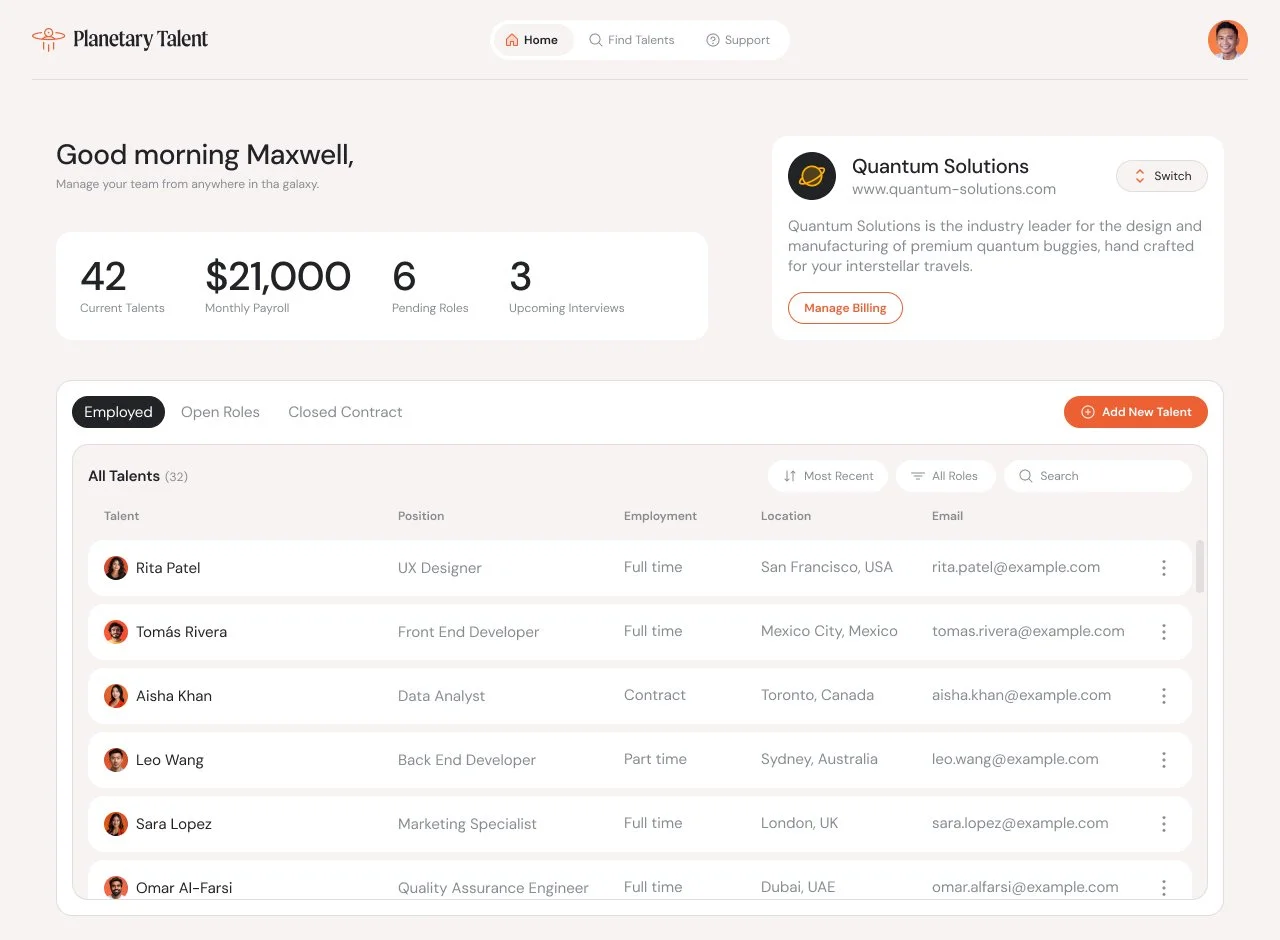
A Planetary Talent dashboard.
Complexity drives confusion, and I had no way to clearly articulate all the intricacies of how we leverage technology to save time for busy entrepreneurs in the hiring process while preserving humanity. It took two days before my fellow cohort members even understood my business.
I realized through this process that we have invented an entirely new way for humans to find other humans in the workplace, and I’ve since been working on how to define this new category of hiring.
We've been following Planetary Talent for a while, and you're an ACCEL-KS grant recipient, so, of course, we're seeing your progress as you move toward commercialization. What was it about the hiring and talent industry that made you think, "Hey, we can solve for this?"
What I love about entrepreneurship is that problem solving does not require any specific degree, credentials, or prior experience. Only a willingness to dig in and work hard stands in your way of becoming a great entrepreneur; Pipeline acts as a forcing function for this work.
I have no background in HR or AI technology, but I do have a background in seeing problems and potential solutions. With business backgrounds, my business partners and I have all hired and built teams before, but it was the emergence of ChatGPT that caught our attention. Suddenly, the possibility existed for candidates to generate spreadsheets of job postings and write a customized resume for each job posting. This turned an already grueling process of reading resumes into a multi-day time suck for already busy business owners.
To counteract this, entrepreneurs did what they do best and innovated their own solutions where ChatGPT would read the resumes or in some cases even interview the candidates, but this dehumanized the process entirely.
My co-founders and I were watching this transition happen in real time, and we realized that, while AI is an incredibly powerful tool, it wasn’t leveraged in a way that benefited humanity in the hiring space. We wanted to leverage technology to rapidly increase the speed and quality of talent matches while preserving the humanity in the process. We do this by using AI to uncover the stories that make people unique: the essence of their humanity. We then build a custom AI agent, which we call a “digital twin”, for each talent and employer, and we let the two digital twins discuss whether or not the role and candidate fit each other’s requirements.
This happens concurrently across thousands of roles and candidates to quickly assess fit, allowing busy entrepreneurs to thoughtfully consider the experiences of each talent without investing their valuable time and allowing talent to put their best self forward for thousands of jobs simultaneously. In this way, we leverage AI to amplify humanity, not erase it.
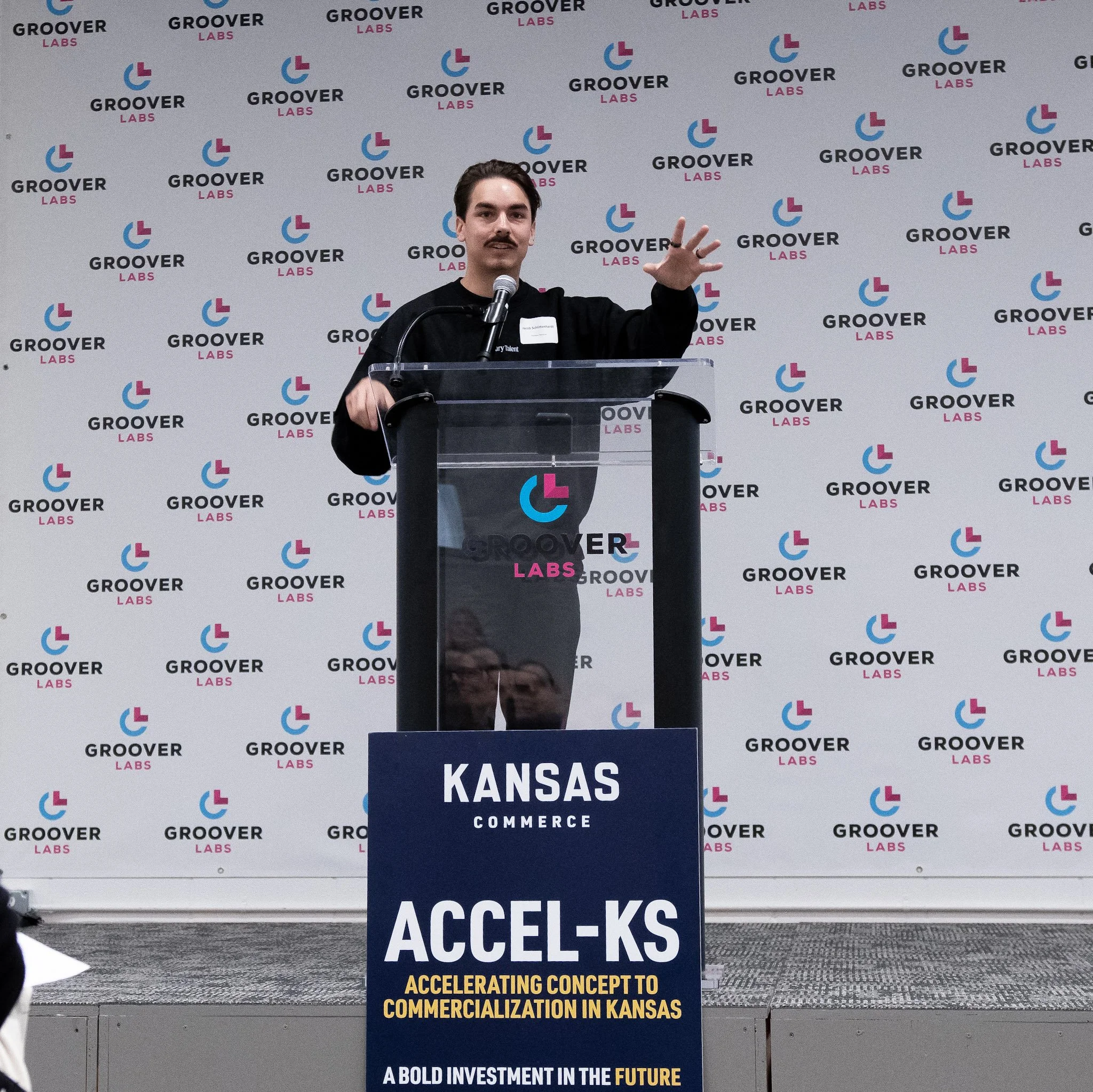
Schlittenhardt delivers Planetary' Talent’s elevator pitch at the ACCEL-KS kick-off event in November 2025
Walk me through what actually happens when a company (a client of Planetary Talent) posts a role.
The concept of “posting a job” actually doesn’t exist in the future we envision. When a new company wants to use Planetary Talent, they just need to communicate to the system the bottleneck they face. Customers can do that on a video call, a voice note, via an online form, an email, or even with a message directly integrated into their workspace such as Slack or Teams.
When the system gets a plea for help, it goes to work determining who is needed to solve the bottleneck. It makes this determination based on the information received as well as data it can gather from publicly available sources, such as the company website or the requestor’s LinkedIn page. Who the company needs could be a single person or a whole team, but if more information, such as budget, is needed to make a clear determination, it will source that information directly from the customer.
After it determines what the ideal talent looks like, Planetary Talent runs job ads to generate interest from potential candidates. These candidates are prompted to answer questions that help us build their digital twin, and then the hiring digital twin and talent digital twin discuss the role requirements and talent experiences.
If the role and the candidates match well, real humans step in to finalize the vetting process and the system helps the talent present their best self to the hiring manager. Then we connect the real humans, so they can have the final conversations.
This process cuts the time to hire down from two months and twenty hours of founder time invested to less than two weeks and two hours of founder time, all two hours of which was spent building relationships with high quality candidates.
Why is Planetary Talent's candidate matching process possible now rather than two or three years ago?
Our system relies heavily on emerging technology, operating at the frontier of what’s possible. We utilize agentic AI technology to tackle all the tasks in the hiring process that humans don’t like doing and aren’t good at.
Unlike other HR tools that build atop the scaffolding of the existing recruiting infrastructure, Planetary Talent looks to reinvent it completely from the bottom up.
What are you hearing from clients, either companies or candidates, after using the platform?
So far, the response has been overwhelmingly positive. Seventy-one percent of customers who used us for one placement have come back to get matched with more talent. Many of our talent applicants who were assessed to not be a fit have kept their profiles open to search for other roles.
We’ve even had a candidate who was declined for a role bring a new potential company to us to utilize Planetary Talent, which I believe says a lot about the experience they had going through our process, even though they didn’t receive the outcome they had hoped for.
How does Pipeline take you to the next stage of development?
Pipeline’s year-long program focuses on resourcing you with the knowledge, connections and guidance you need to grow your business. The program gives you access to top industry experts and mentors who will challenge you to think differently about your business. I’m excited for the business and leadership lessons I’ll pick up along the way.
What's the biggest misconception people have when they hear about Planetary Talent?
Often times people bucket our company into two categories: recruiting firm or AI hiring software. Neither of those assessments is correct. People like to categorize things by finding related concepts and connecting them. How often do you hear people say, “It’s similar to…” or “That’s like…” Association is human nature.
Unfortunately for us, we are building something new, and that doesn’t fit neatly in a category. Recruiting is being reinvented. Many new startups cram AI into the process to strip the human element out of the hiring process and reduce people to keywords. We are working to match humans in meaningful ways, based on their stories, to make the hiring experience truly joyful for the first time in history. The future is not recruiting; it’s talent intelligence.
Just a comment here: we had the chance to see a product demo recently from the candidate side and the client side. It's a beautiful interface with an intuitive design. Hiring platforms are fraught with unnecessary steps for candidates and companies. How did you overcome the challenge of eliminating the unnecessary and at the same time finding the stories that matter most to companies and candidates?
This is a great question and it gets to the secret we uncovered about hiring. Hiring is a storytelling problem, not a skill assessment problem. The world is a big place, and lots of humans have the skills you need, but not the stories you need. We realized that story is the human element that ChatGPT can’t fake. AI doesn’t know the experiences that you’ve had unless you tell it.
That’s why our talent intake process focuses on thoughtfully collecting stories. It’s these stories that make each person unique and inform their digital twin. The more thorough the story and the more experiences we can draw from, the more information your digital twin has to use when advocating for you.
With a background in product design, it was critical to me that the experience be human friendly. After all, humans are why we built this company in the first place.