
The Groover Way: Problem Solving Through Prototyping
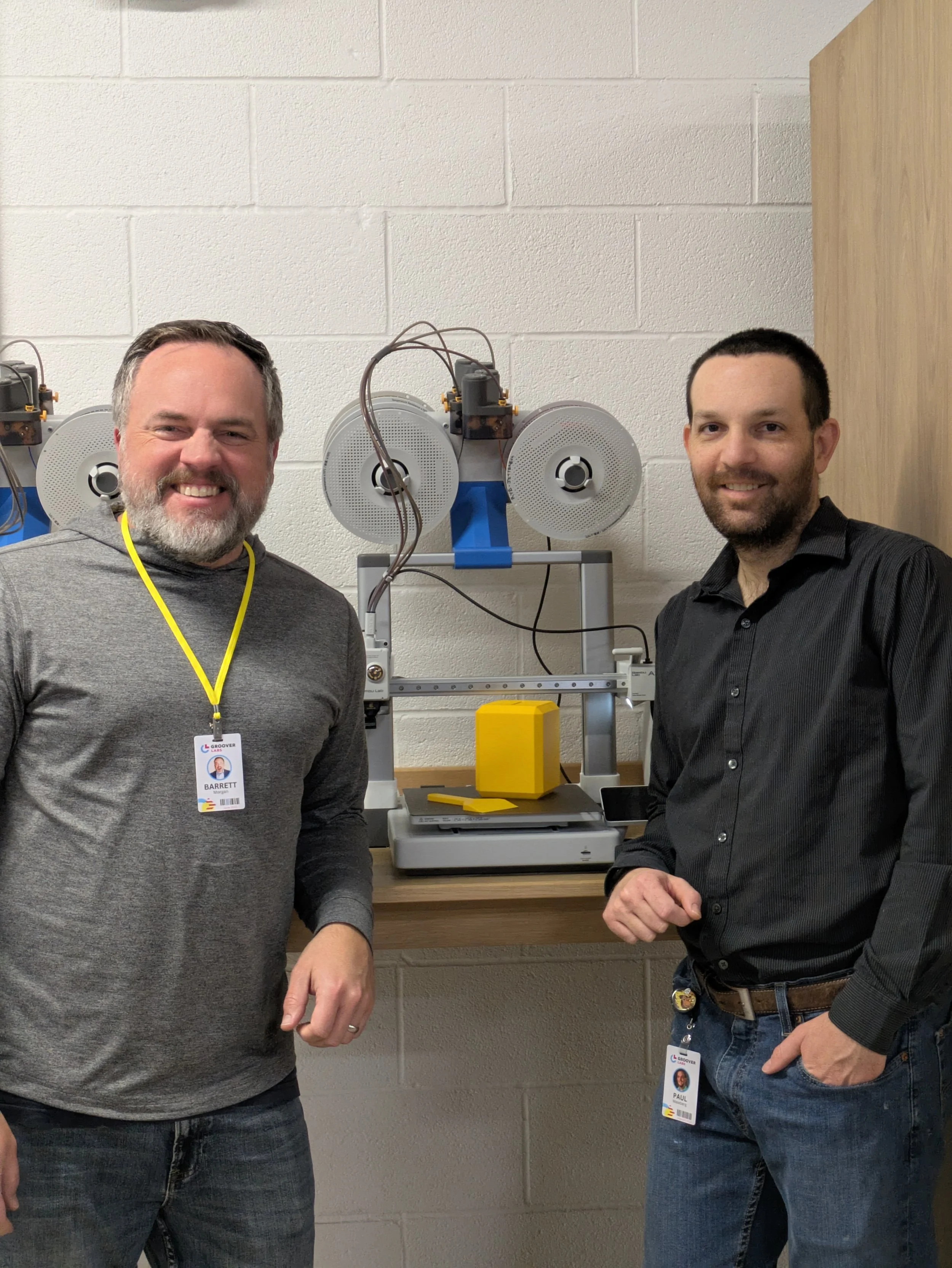
Barrett Morgan and Paul Maseberg standing near a 3D printer.
At Groover Labs, our members and staff have a startup mindset. When we encounter a problem, we ask how we can innovate while keeping things lean.
A stable network at Groover Labs is like the road you drive to get here. It’s invisible infrastructure that’s critical for our members. Our IT volunteer, Paul Maseberg, implemented and continues to manage that network. And in true Groover Labs ethos, when he encounters a problem that has a lousy market solution, he asks, "Can’t we build this ourselves?"
That's how we roll.
Internet access is so commonplace now that it’s easy to take for granted all the physical technology that needs to be in place to make it work, like servers, switches, routers, and miles and miles of cable.
Keeping the network running and up to date requires a lot of attention; keeping it organized and tidy can be a challenge. We need specialized brackets, off-the-shelf zip ties, and velcro straps to keep track of the networking cables. When we can’t find the parts we need to upgrade and extend the network, we return to our roots.
After working around this problem for a while, Paul realized that if he couldn’t find a better solution, why not build it? Or print it, to be more precise.
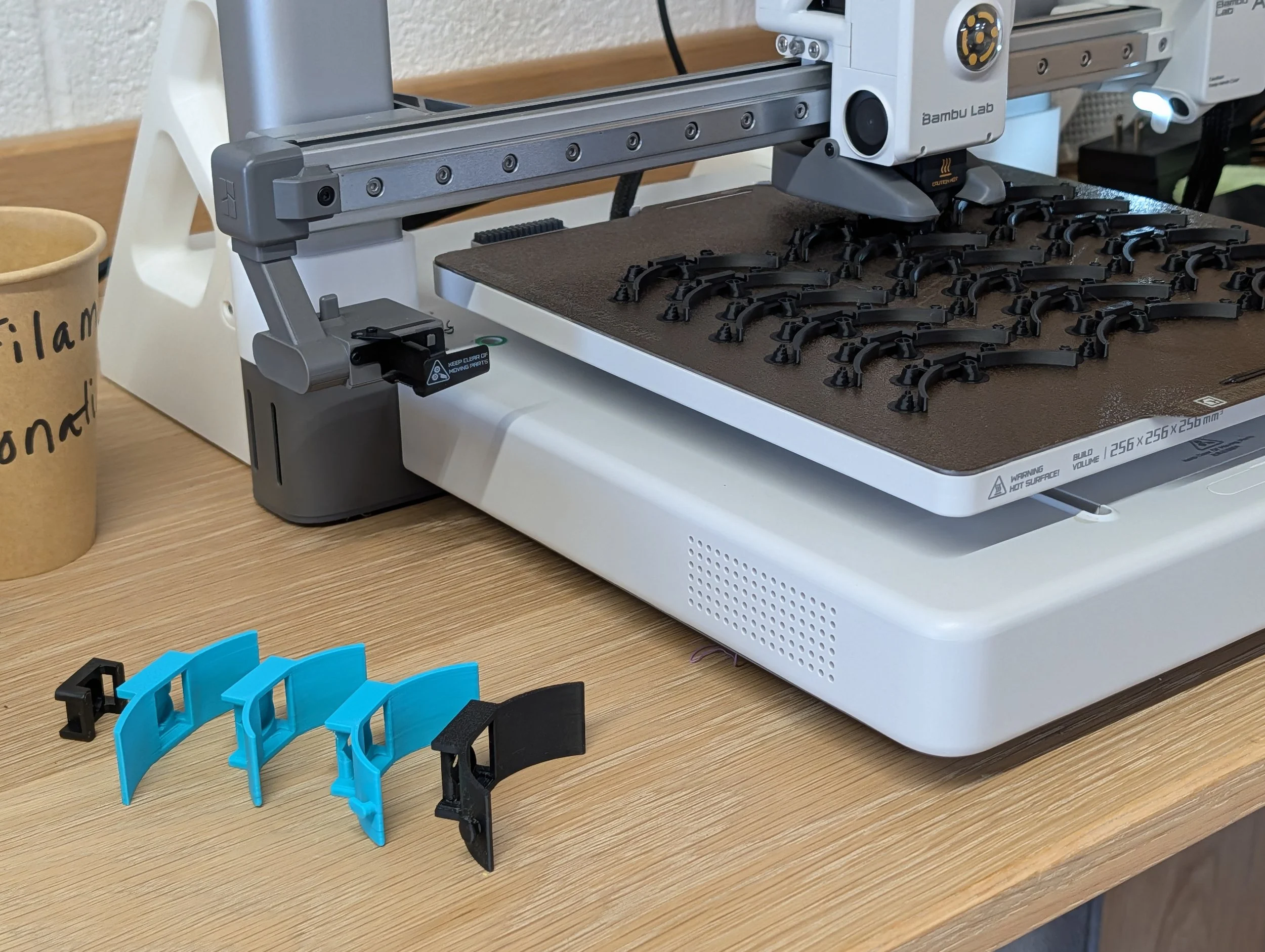
Prototype and final brackets being printed on the Bambu Labs 3D printer.
“When I need to find a good solution for a simple problem,” Paul said, “3D printing always comes to mind. There are basically infinite ways to design even simple parts, and a 3D printer 'unlocks' all the possibilities.”
Just because someone is an expert at one thing doesn’t mean they’ll be an expert at another, and that’s how Barrett Morgan, co-owner of Trailmark Creative, became involved.
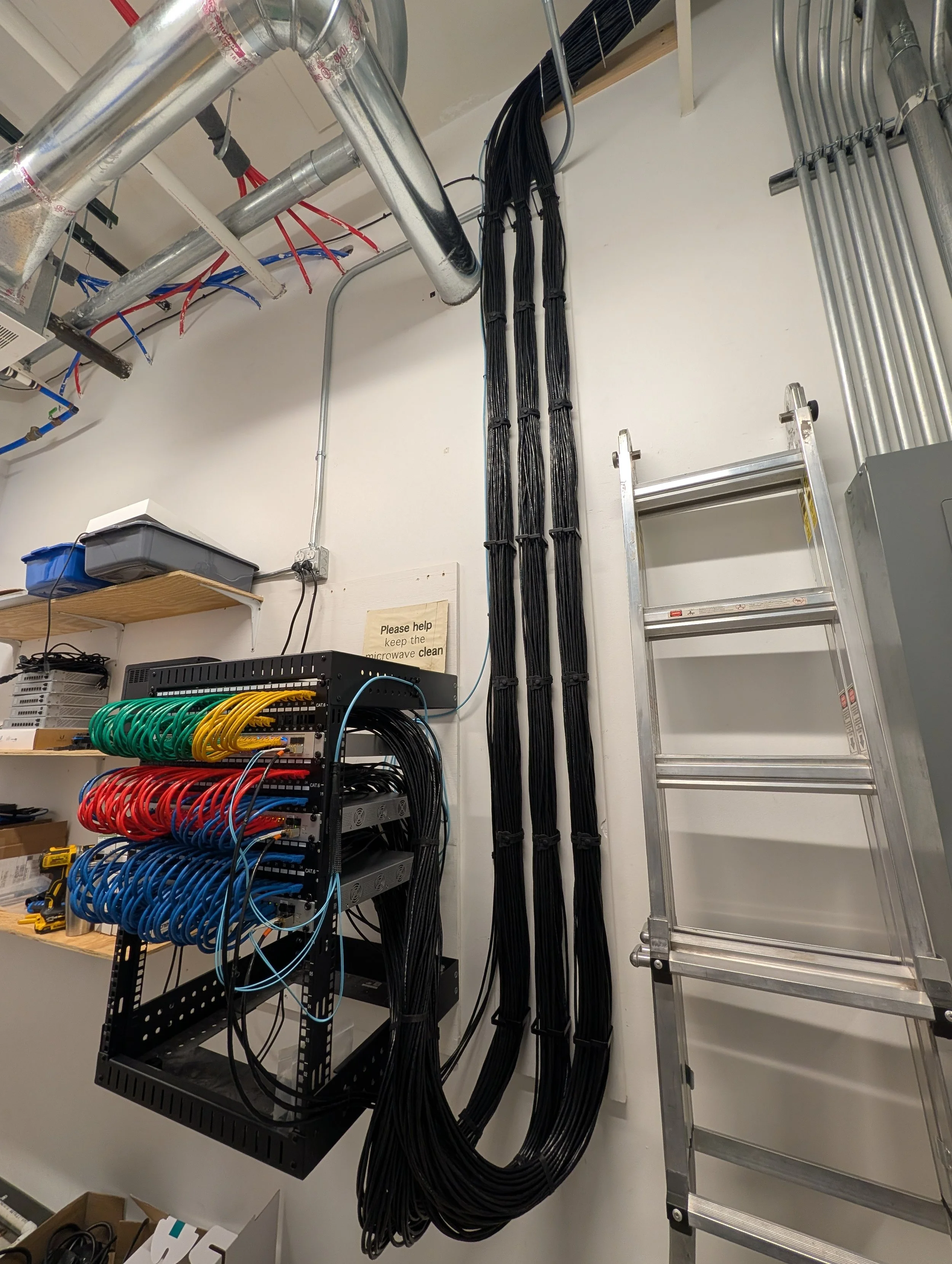
Network cables neatly arranged.
“Paul met with me in the Hotseat area one afternoon and shared the problem he was trying to solve with cable management,” Barrett explained. “After taking the Groover Labs 3D printing class, I've tried my hand at a few modeling projects, and the word's gotten out. He showed me an initial part and what he would like added to it. I volunteer in the Maker Space, so I was glad to volunteer some time to support Groover Labs' infrastructure.”
Using a digital caliper to measure an existing part and Fusion 360 to create a 3D model, Barrett created the first iterative prototype using one of our Bambu Labs printers.
It took four iterations over four lunch breaks for Barrett before landing on the final design.
Paul, explaining the refining process, said, “Each time we just 'gave it a try’, and when we had the physical print, we could see improvements pretty much instantly. Make the slot bigger on the tie to fix. Make the curve more round to match the cable bundle. Tweak the pins to hold the tie better. It is a very quick process once you have a part.”
This is the Groover way. Our members tackle problems with creativity and collaboration out of curiosity and a desire to see if a better solution is possible. Sometimes there is, sometimes there isn’t, but either way, we’re going to learn something. And that helps us appreciate it all the more.
“3D printing, even simple projects, always makes me see common products in a new light,” Paul shared. “We see and interact with all kinds of 'things’ every day. Making something from scratch makes me understand just a little of what the modern world is built with.”
