
Volunteer Interview Michael Hogan
At Groover Labs, we always have a handful of projects and improvements going on. As the Maker Labs and Facilities Manager, Jeremiah Burian does an excellent job coordinating and managing all those moving parts, but it wouldn’t be possible to get everything accomplished without our volunteers. Our volunteers are both experts in their own disciplines and usually looking to grow and improve with new projects.
Meet Maker Labs Volunteer, Michael Hogan!
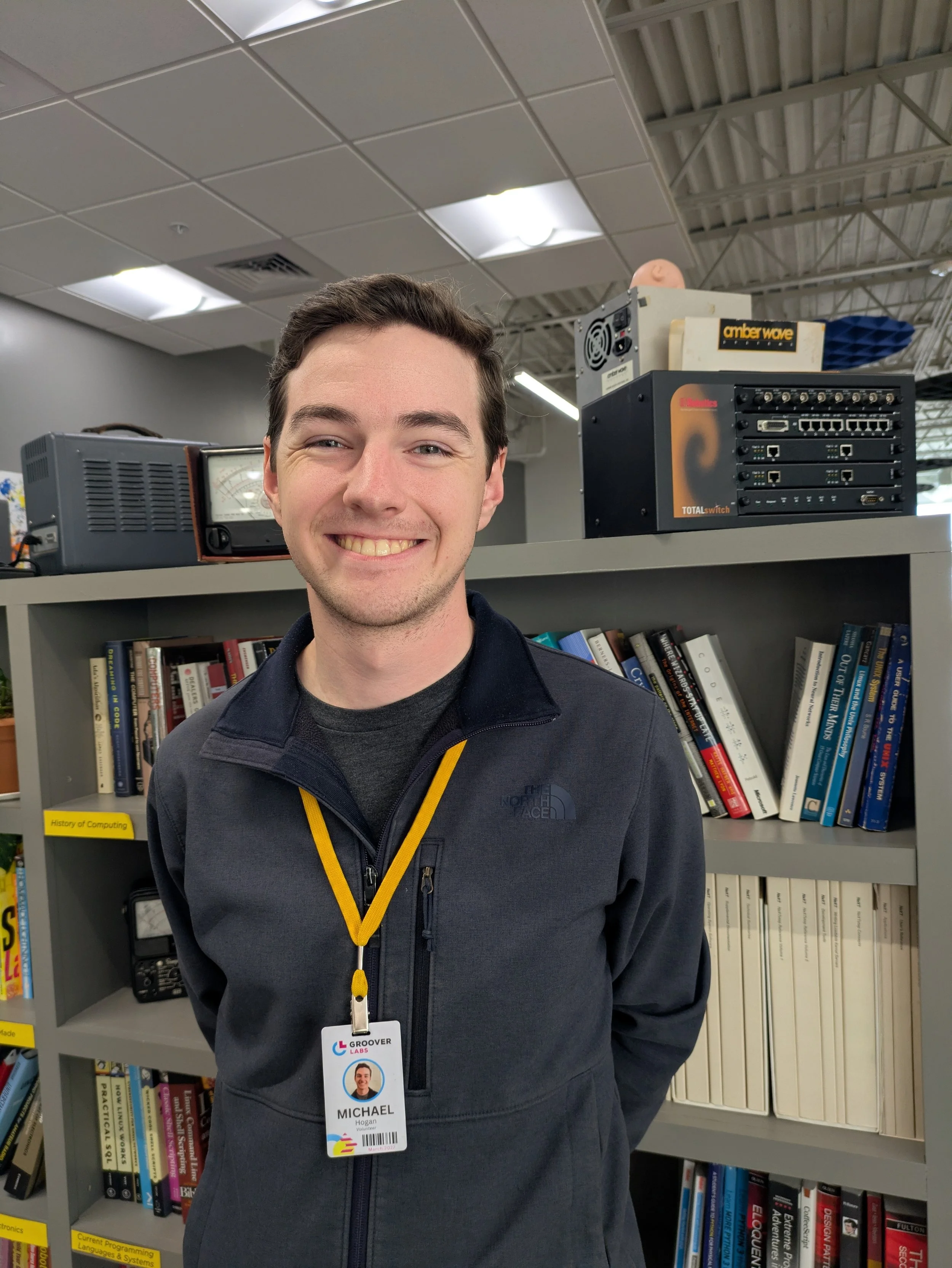
Michael Hogan
Which skills do you believe you've strengthened during your time volunteering with Groover Labs?
Drawing up plans - I've gotten a fair bit of practice from designing the workbenches that will be built for the makerspace, especially since I'm not the only person working on them. There's a number of details that need to be thought through ahead of time with regards to what you want your final dimensions to be, what materials are available to you, and what the best way to form the parts you actually need from those materials is.
If you had the chance to launch a startup to solve any problem, what problem would you choose and why?
One problem that I'd like to tackle regards various devices and/or appliances. Take, for example, a sprinkler controller. Most of the designs out there tend to be proprietary and, more importantly, require internet access to operate. A number of questions arise from this combination, such as: What data is the company collecting about you and your network? How secure is the data they've collected? Can the company lock you out of your own device if they decided to? These, along with many others, are questions that don't have easily found answers. Moreover, when something fails on the device (e.g., a single zone fails on the sprinkler controller because a relay failed), it's prohibitively difficult to repair, since you have to take the time to understand how the device is designed and figure out exactly what went wrong.
What if it didn't have to be like that, though? What if you had an open-source product that the end user could easily modify, repair, and reprogram? For example, a sprinkler controller that exposes a programming interface and has open-source documentation for both the software and the hardware. A sprinkler controller that has support for various modules (e.g., modules with support for WiFi, Bluetooth, LoRa, etc.) so that the users can have their devices be as smart or dumb as they want (thus potentially ensuring the device is physically unable to report data back to us). Beyond that, they could not only look through our software themselves to validate what information we collect (anonymous debugging information being the only thing I can imagine we might collect - and likely not even that) or write their own software to have complete control over their device. The open source model enables the users to add their own features, design their own modules, and perform their own repairs.
The core of the challenge will be solidly designed products that just work (i.e., very simple and easy to set up and use even without much technical background), with robust documentation for both the hardware and software so that it is also easily modifiable and extensible. While there is certainly the risk (or, more probably, the inevitability) of far cheaper competitors stealing the design and releasing their own clones, I believe there's still plenty of room in the market for units with a known, established quality whose purchase will benefit the people who actually worked to design the product.
Is there a piece of equipment at Groover Labs that you're really excited about, even if you haven't had the chance to use it yet?
Oof. That's a tough one. I don't know that there are many tools in the Maker Lab that I'm not excited about, but I guess I'm probably most excited about the metal shop as a whole - though particularly the welders and lathe. I haven't had much experience with either, but I'm excited to learn to use them since it should open up a lot of possibilities with regards to the stuff I can build. Honorable mentions also go to the battery spot welder in the Electronics Lab and the planer in the Wood Shop.
In what ways do you think Groover Labs, and especially the Maker Labs, can help founders and entrepreneurs?
Firstly, in the community that is built here. It's been my observation that everyone at Groover tends to go out of the way to support other members - sometimes with advice, mentoring, or talent referrals, sometimes by just talking about them and sharing the word.
For those that are developing a physical product, the Maker Lab has pretty much everything you could possibly need to develop a prototype, and Groover has proven in multiple cases that they're willing to step up and help companies with the awkward scaling issue of going from one or two prototypes to full-scale production. They've also been great at lending their knowledge when a business may lack talent in a certain area.
How did you first learn about Groover Labs?
The first time I ever heard about Groover Labs was actually from Dave Cunningham, though I didn't actually start coming to Groover Labs with any consistency until I started working for Greenfield Robotics which worked pretty closely with Groover (especially Curt Gridley) - especially while developing the vehicle control unit they use in the bots now.
What inspired you to volunteer?
The single biggest reason I volunteered is Curt. I had the privilege of working with Curt a number of times, and I came to admire him and his dream of helping startups to succeed. To me, volunteering at Groover is a small way in which I can contribute towards making Curt's vision a reality.
